AI-powered product discovery: how AI finds products

Written by
Mario Weddell
Shoppers are becoming more comfortable using AI tools to help them find the right products.
Every time someone searches for a product online—whether it’s on Google, ChatGPT, Amazon, or another marketplace powered by AI—they’re not just scanning a list of results. They’re being shown what the platform’s algorithms think they’ll want to see.
Some products rise to the top. Others never get surfaced at all.
That’s not random. Behind the scenes, artificial intelligence is doing the work of interpreting search terms, evaluating product data, comparing listings, and deciding what to show—and in what order. The ultimate goal is to improve customer satisfaction and conversion rates.
If you learn how to optimize your listings for AI-driven ecommerce, your online store can show up in more product searches and even improve conversion rates.
This article explains how the AI search experience works for product listings. We examine what happens in an AI-driven search that leads to a product recommendation. Learn how generative AI interprets language, retrieves listings, and filters them based on your product data.
And for the SEO experts out there, we also answer the question, “Do keywords matter for AI search?”
This blog breaks down key concepts like semantic retrieval, shared tokens, structured data, and unstructured data—with plain-language explanations and real-world use cases that make the mechanics easier to understand.
Whether you’re a brand, a retailer, or just curious about how AI product recommendations happen, this is a look into the system that’s quickly shaping the future of online shopping.
Once you understand how AI finds products, check out our next blog about AI-powered product discovery to learn how AI ranks and recommends products above others.
The engine under the hood: how AI search works
Let’s say someone searches for a “lightweight trail running shoe” on Google Shopping or a voice assistant. Somewhere in a massive product index, there’s a match—or at least a shortlist of contenders. But the shopper never sees all of them. Only a few products rise to the top. So what actually determines which one shows up?
To understand that, it helps to start with the raw material AI is working with: the product listing itself.
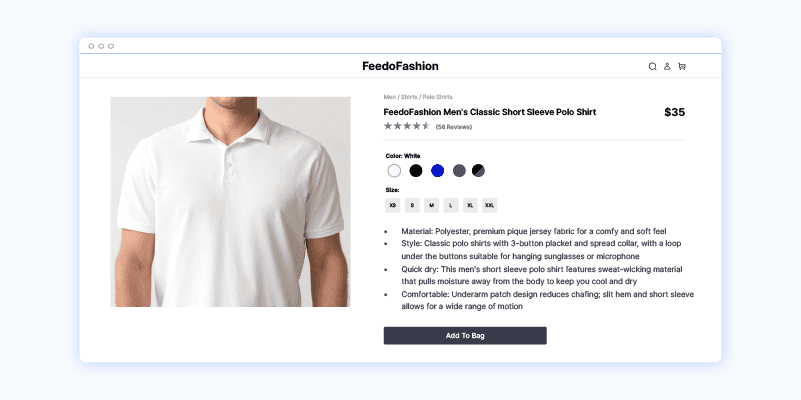
AI search platforms see all the structured and unstructured product data in a listing. This is not a trail running shoe, but you get it.
What artificial intelligence sees in a product listing
Product data is the backbone of ecommerce, so of course it’s very influential in AI-powered search. It doesn’t matter if you’re selling products through an online store with a platform like BigCommerce or Shopify, on social media channels like TikTok, or on marketplaces like Amazon and Walmart—the quality of your product listings has a major impact on your conversion rates and the customer experience.
If you want to optimize your listings, you need to understand how AI search algorithms analyze product data in near real-time to determine relevance.
Every product listing is made up of two main types of data:
Structured data is the technical stuff—catalog fields like color, size, material, brand, gender, price, and availability. This is what gets mapped to filters and dropdowns. It’s formatted to be read by machines.
Unstructured data includes free text like the description, reviews, or even captions in visual content. It’s messy, but rich with context. This is where shoppers (and AI) get a sense of what the product is.
Product titles occupy a gray area between structured and unstructured data. They are technically structured data, required in catalogs, and expected to follow best practices (brand + product type + key attributes). But they are also analyzed by AI to gather meaning and intent, and to determine relevance for search results.
In our example, a product listing could look like this:
Title: “Men’s Lightweight Trail Running Shoes – Breathable Mesh”
Color: Navy
Category: Footwear > Athletic > Running
Description: “Designed for off-road running, with a flexible sole and moisture-wicking upper.”
Tags: trail, outdoor, running, lightweight, breathable
This is some of the information that AI search engines use to determine whether the product matches a user’s intent, but not all of it. Let’s continue.
Feedonomics makes data optimization easy
How AI uses Natural Language Processing to interpret a product search
AI doesn’t just look for keywords anymore. It uses Natural Language Processing (NLP) to understand what a shopper means, to surface relevant products that might not match your search verbatim.
NLP is what allows AI-powered search tools to recognize that “trail running shoe” is a type of footwear, that “lightweight” refers to comfort or material, and that “breathable” implies performance features. It does this by breaking down language into mathematical representations.
Key terms defined:
Natural Language Processing (NLP)
The field of AI that enables machines to understand and interpret human language. In ecommerce, NLP helps AI systems understand shopper queries like “shoes for muddy trails” and match them to listings that mention “waterproof trail running shoes,” even if the words don’t exactly align.
Analogy: Think of NLP as teaching a machine how people talk, so it can make smart connections between related words and ideas.
Vectors and embeddings: the coordinates of meaning
Here’s where things get more technical, but you don’t have to be an expert to get the concept.
Imagine a giant universe of language, represented by a multidimensional map. Every word or phrase is charted onto the map of the universe, so that similar concepts are clustered closer together. Of course, this map is not a literal thing, but it’s helpful for illustrating the general idea.
In order to navigate the map, AI uses a process called embedding to convert user search queries (e.g., “what’s a good lightweight trail running shoe?”) and online product listings into sets of coordinates on the map.
These coordinates are called vectors. These vectors allow the AI to mathematically compare how similar two concepts are. The closer the vectors are in space, the more semantically similar they are, which increases the likelihood that the product will be shown in the results of a search.
On the giant language map…
“Sneakers” and “running shoes” might land in the same neighborhood.
“Boots” and “heels” might be nearby, but in a different cluster.
“Navy” and “dark blue” could be close—or not—depending on how the AI was trained.
So when a shopper types “lightweight trail running shoe,” AI models convert that phrase into a vector and look for product listings with vectors that land close by.
This is known as semantic retrieval. It allows AI to surface products that don’t contain the exact words in the query, but still match the shopper’s intent. Basically, it’s the process of making connections or deriving meaning from words.
Machine learning has enabled AI search tools like ChatGPT, Perplexity, Gemini, and Google search using AI mode to create a better user experience. Even if shoppers do not hit all the “keywords” that you have in your product listing, AI uses a combination of customer preferences and natural language processing to provide personalized recommendations and display relevant products.
Speaking of keywords, keep reading to see how AI-generated search actually depends on “tokens” rather than the keywords of traditional search.
Key terms defined:
High-dimensional space
The “map” where AI places vectors. Instead of just using a few dimensions like height, width, and depth, this map has hundreds of dimensions, each representing a different nuance of meaning—like tone, function, material, or category.
Analogy: Imagine organizing shoes not just by color and size, but also by breathability, season, trendiness, price, brand tone, and 100 other traits—all at once.
Semantic retrieval
A method where AI retrieves products based on meaning, not just exact keywords. It uses vector comparisons to return listings that are close in intent—even if the wording is different.
Example: A product search for “eco-friendly laptop case” could retrieve products labeled “recycled neoprene tech sleeve.”
Do keywords still matter for AI search?
If you’re familiar with traditional search and SEO, you might be wondering if keywords play a role in how AI finds products.
Even though AI can retrieve relevant results without exact or even partial keyword matches, exact matches still play a role—especially in highly competitive product categories. However, in AI search, the concept of a “keyword” is loosely replaced by a “token” to reach the next level of product discovery.
Tokens are the individual words or components that AI extracts from a search query or a product listing. Think of them as the building blocks AI uses to determine meaning. When a product listing shares tokens with a shopper’s query—like “trail,” “running,” or “lightweight”—that overlap can increase its relevance score.
For example, if one product title says “lightweight trail shoe” and another says “performance off-road trainer,” both may be semantically similar, but the first is more likely to rank higher because it shares more tokens with the query.
That said, language consistency matters. Covering all your bases with different tokens can backfire. If your listing uses “navy” in one field and “blue” in another without clarification, or mixes terms like “trainer” and “running shoe” without reinforcement, it can dilute the match. What does reinforcement mean in this context?
Reinforcement means supporting or clarifying a term by pairing it with a more commonly used or semantically aligned phrase to help AI make the correct association.
In this case, reinforcement helps AI understand that two different terms (like “trainer” and “running shoe”) are referring to the same or similar concept, even if they don’t share the same tokens.
Example of reinforcement in action:
Without reinforcement
Title: “Men’s Performance Trainer” Description: “Built for off-road grip and speed.”
AI may be unsure if “trainer” = “running shoe,” especially if the term “running” is never used.
With reinforcement
Title: “Men’s Performance Trainer (Running Shoe)” Description: “This running shoe offers the support of a classic gym trainer with trail-ready grip.”
Now the listing uses both terms, reinforcing the idea that they’re related. This improves AI understanding and semantic matching.
Remember that AI tokenizes all the text in your product listing, not just the title. Descriptions, bullet points, and even alt text contribute to the overall signal. The clearer and more consistent your language, the easier it is for AI to recognize and recommend your product.
How Feedonomics optimizes product data for AI-powered discovery
AI-powered product discovery starts with high-quality product data—and that’s where Feedonomics gives you a critical edge. By centralizing and optimizing your structured and unstructured product data, Feedonomics ensures your listings are not just complete, but fully primed for how AI systems read, interpret, and surface products.
On the structured data side, Feedonomics makes it easy to enrich, normalize, and standardize key fields like product category, size, color, availability, GTIN, and price across every sales channel.
You can create rule-based transformations to align terminology (e.g., converting all instances of “dark blue” to “navy”), fill in missing values, or map internal attributes to platform-specific taxonomies. This ensures consistent tokens across fields—something AI systems rely on for relevance scoring and accurate semantic matching.
For unstructured data, Feedonomics helps you streamline and automate content updates that support NLP-based AI tools. Whether it’s injecting performance-oriented language into product descriptions, reinforcing synonym relationships (like “trainer” and “running shoe”), or managing alt text for visual search indexing, Feedonomics provides the tools to align your content with real-world shopper intent. You can also use business rules to generate SEO-optimized bullets, or create dynamic descriptions—all without manual effort.
In short, Feedonomics acts as the connective tissue between your raw product data and the AI engines powering modern commerce. By automating optimization at scale, you can ensure your products are not only available but discoverable—whether a customer is searching on Google, browsing a chatbot, or uploading a photo in a visual search tool.
Now that you understand how AI finds products, check out our next blog about how AI ranks and recommends products above others.
Help AI search platforms find your products


